
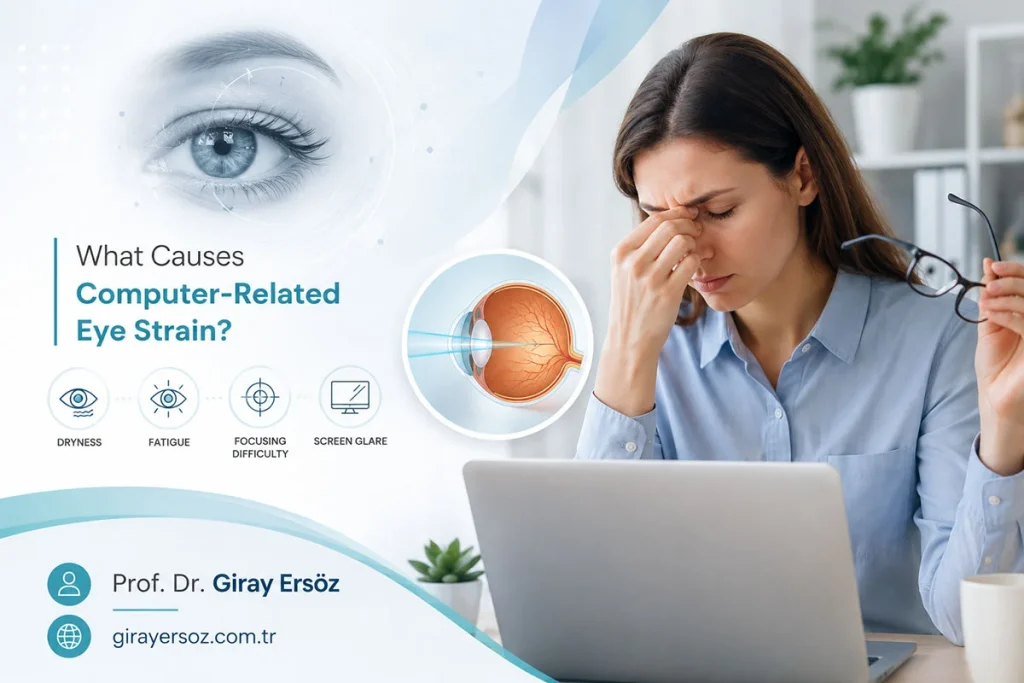
Complaints of eye strain have increased noticeably as computers and other digital screens have become an inseparable part of daily life. Many patients consult ophthalmologists with symptoms such as burning, stinging, blurred vision, or headache after using a computer for long periods.
This condition is medically referred to as digital screen-related eye strain, commonly known in English as Digital Eye Strain. In this article, I will explain the causes and mechanisms of computer-related eye strain.
What Is Eye Strain (Digital Eye Strain)?
Eye strain is a group of symptoms that occurs after prolonged near-distance visual activity. Although it is often temporary, it can affect quality of life. Looking at screens such as computers, tablets, and mobile phones for long periods is among the most important factors that trigger this condition.
In scientific studies, eye strain is described with complaints such as dryness of the eyes, burning sensation, stinging, blurred vision, headache, and difficulty focusing.
Why Does Computer Use Tire the Eyes?
Reduced Blinking Frequency
Research shows that blinking frequency decreases significantly while looking at a computer screen. Normally, the average number of blinks is around 15–20 times per minute, but during screen use this number may decrease by more than half.
This causes the ocular surface to remain insufficiently moisturized and may increase dry eye symptoms.
Continuous Near Focusing
Computer use requires the eyes to focus at a near distance for long periods. This may lead to fatigue in the muscles responsible for the eye’s focusing mechanism.
Especially when working for long periods without breaks, blurred vision and difficulty focusing may occur.
Screen Contrast and Brightness
Text and images on screens have lower contrast compared with printed text. In addition, when screen brightness is not compatible with ambient light, the eyes need to make more effort.
Scientific studies show that inappropriate screen brightness may increase eye strain complaints.
How Important Is Blue Light in Eye Strain?
Blue light is a part of the short-wavelength visible light emitted by digital screens. There is no strong clinical evidence showing that blue light causes permanent retinal damage at the levels encountered during daily screen use. However, it is known that blue light exposure, especially in the evening hours, may affect sleep patterns.
From the perspective of eye strain, current scientific data indicate that blue light alone is not the main cause. Reduced blinking frequency and prolonged near focusing appear to be more determining factors.
Does Eye Strain Cause Permanent Damage?
This is one of the most frequently asked questions by patients. When scientific studies are evaluated, computer-related eye strain usually does not lead to a permanent eye disease.
However, prolonged and intensive screen use may make symptoms more noticeable, especially in individuals with existing refractive errors or dry eye problems. Therefore, symptoms of eye strain should be taken seriously and appropriate precautions should be taken.
Who Is at Greater Risk?
According to scientific studies, eye strain is more likely to occur in the following groups:
- People who use computers for long hours every day
- Individuals with uncorrected refractive errors
- People with dry eye disease
- People who use screens in an unsuitable working environment
In these groups, symptoms of eye strain may appear earlier and may last longer.
Is Eye Strain Related to Other Eye Diseases?
Computer-related eye strain alone does not cause cataract formation or the development of myopia, hyperopia, or astigmatism. Scientific studies do not support that screen use directly initiates or accelerates these conditions. However, eye strain may sometimes make existing eye problems more noticeable.
In individuals with uncorrected refractive errors, complaints often increase while working in front of a screen. In such cases, the person may feel as if their “eye prescription has increased.”
Cataract is mostly an age-related lens disease, and computer use is not a known risk factor for cataract. In some patients who have undergone cataract surgery, eye strain may be felt more clearly, especially during prolonged screen use. This is usually related to dryness of the ocular surface or visual strain caused by near-distance use and is generally not permanent.
You can find detailed information about cataract and cataract surgery in the articles below:
- What Is Cataract? Cataract Symptoms and Treatment
- How Is Cataract Surgery Performed? Risks and Postoperative Process
Frequently Asked Questions (FAQ)
Does everyone who works at a computer experience eye strain?
Not everyone who works at a computer is expected to experience eye strain. The development of eye strain varies depending on personal factors and working conditions.
Does eye strain cause an increase in eye prescription?
It has not been shown that eye strain alone causes an increase in eye prescription.
Is it necessary to use computer glasses?
Computer glasses are not necessary for every individual; however, they may be beneficial for some people when recommended by an ophthalmologist.

When Are Flashes of Light in the Eye Dangerous?
Sudden bright lights in the eye, short flashes similar to lightning, or a sudden sensation [...]
Devamını OkuyunSep
What Causes Computer-Related Eye Strain?
Complaints of eye strain have increased noticeably as computers and other digital screens have become [...]
Devamını OkuyunAug
What Causes Straight Lines to Look Wavy?
Straight lines may sometimes no longer appear straight to the eye. If door frames, window [...]
Devamını OkuyunAug
What Is Smartphone Blindness? Can It Cause Temporary Vision Loss?
Have you ever noticed short-term vision loss in one eye after looking at your phone [...]
Devamını OkuyunJul
How Can I Tell If My Eye Prescription Has Increased?
Your eye prescription may change over time. Sometimes this change is not noticed immediately; instead, [...]
Devamını OkuyunJul
What Causes a Sudden Curtain-Like Shadow Over the Eye?
If you suddenly experience a darkening, shadowing, or closing sensation as if a curtain has [...]
Devamını OkuyunJul
How Is an Eye Examination Performed? When Should It Be Done in Babies and Children?
An eye examination is a medical evaluation that is vital for protecting eye health and [...]
Devamını OkuyunJul
What Is Hyperopia (Farsightedness)? Causes, Symptoms and Treatment
Hyperopia is one of the most common vision problems seen both in Türkiye and around [...]
Devamını OkuyunJul