
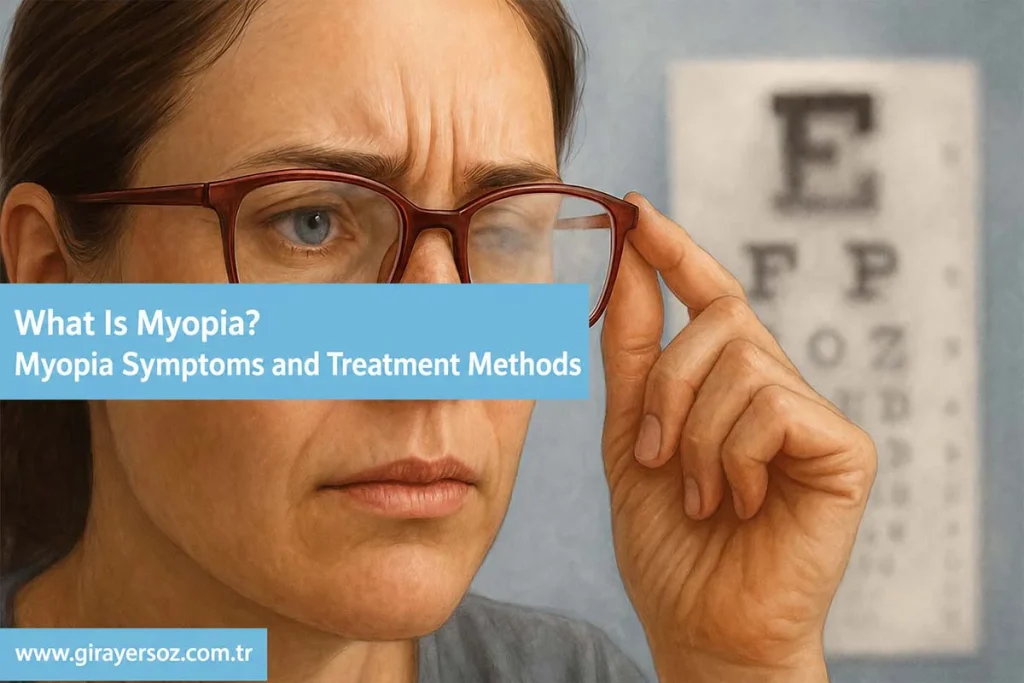
Myopia, commonly known as nearsightedness, is a refractive error of the eye. People with myopia see distant objects blurred, while near objects are usually seen clearly. This condition has been increasing rapidly, especially among children and young people. In this article, you can find answers to the most common questions about myopia.
What Is Myopia?
Myopia is a visual disorder that occurs when images from distant objects focus in front of the retina instead of directly on it due to a refractive error of the eye. As a result, near objects appear clear, while distant objects appear blurred.
Normally, light entering the eye is refracted by the cornea and the natural lens, then focused on the retina to create clear vision. In a myopic eye, however, the eyeball may be longer than normal or the cornea may be too curved. Because of this, light focuses in front of the retina and a clear image cannot be formed.
Myopia is one of the most common refractive errors worldwide and usually begins during childhood or adolescence. The prescription may increase with age and then generally stabilises. In people with high myopia, defined as 6 diopters or more, the risk of serious eye diseases such as retinal detachment, glaucoma and early cataract increases.
Degenerative, or pathological, myopia is less common. It usually begins in early childhood, follows a progressive course and may lead to permanent retinal damage over time.
How Do People With Myopia See?
People with myopia see distant objects blurred and near objects clearly. This visual problem becomes noticeable in daily life while watching television, driving or reading text on a classroom board. The amount of blur varies according to the degree of myopia. In low myopia, blurring may be mild, while in high myopia, there may be significant loss of clarity.
Because light focuses in front of the retina in myopic eyes, letters, shapes and faces at a distance may be difficult to recognise. This becomes more noticeable in low light and in the evening. People with myopia should have regular vision tests and use glasses or contact lenses with the correct prescription. Not using glasses when needed may cause headaches, eye strain and concentration problems. Sitting closer to the front in classrooms or meetings and keeping digital screens at a comfortable viewing distance may help improve visual comfort.
How Does Someone With -1.00 Myopia See?
Low myopia, such as -1.00 diopter, causes mild blurring of objects around 4–6 metres away. At near distances, the person can usually read a book, phone or computer screen clearly. People with -1.00 myopia may not always feel the need to wear glasses in daily life, but they may have difficulty while driving or reading text on a board.
Although the prescription is low, visual problems may become more noticeable at night or in low-contrast environments. Glasses or contact lenses may be recommended for specific activities such as driving or sports. Temporary blurred vision may occur more often after looking at digital screens for a long time.
How Does Someone With -2.00 or -3.00 Myopia See?
People with moderate myopia, such as -2.00 to -3.00 diopters, can usually see clearly only at around 1–2 metres. Distant objects, such as road signs or people across the street, become noticeably blurred. People with -2.00 or -3.00 myopia may notice their visual difficulty more during walking, sports or social activities.
As the degree of myopia increases, focusing becomes harder and glasses or contact lenses are usually needed for almost all distance vision activities. If myopia progresses, secondary complaints such as headache, burning sensation in the eyes and eye strain may occur.
How Far Can a Person With Myopia See Clearly?
The clear viewing distance changes according to the degree of myopia. For example, a person with -1.00 myopia can generally see clearly up to about 1 metre, while a person with -3.00 myopia may see clearly only up to about 33 cm. In simple terms, each -1.00 diopter of myopia reduces the clear viewing distance. Therefore, a person with -3.00 myopia may not be able to see objects farther than about 33 cm clearly without correction.
What Are the Causes of Myopia?
There are several factors that can cause and influence the development of myopia. Genetic predisposition, environmental factors and lifestyle habits all play a role. Increased technology use, prolonged screen time and near-focused activities may increase the risk of myopia in children and young people. Exposure to daylight and time spent outdoors are also important. Spending at least two hours outdoors each day may help slow the development of myopia.
Parental myopia is also an important factor. If one parent has myopia, the risk of myopia in the child may increase; if both parents are myopic, the risk may be even higher.
What Causes Myopia?
The main cause of myopia is that the eyeball is longer than normal. In myopia, the eye becomes elongated and light focuses in front of the retina. Increased refractive power of the cornea or natural lens may also cause myopia. If the cornea is too curved or the lens is too thick, the image may not focus clearly on the retina.
Excessive near work may contribute to the development of myopia. Continuous reading or screen use can lead to visual fatigue. Some infections or health problems during infancy or childhood may negatively affect eye development. Genetic mutations may also increase the tendency to develop myopia.
Genetic Factors and Hereditary Myopia
The risk of myopia is higher in people with a family history of myopia. If both parents are myopic, the likelihood of myopia in children increases. Genetic variations can affect eye structure, and different gene changes may influence eye elongation or corneal shape.
Hereditary myopia often begins at an early age. In cases of high myopia detected during childhood, family history is an important factor. The risk may increase further if siblings or close relatives also have myopia.
Environmental Factors and the Effect of Lifestyle
Spending long periods in front of computers, tablets and phones may cause visual fatigue and contribute to myopia development. Spending less time outdoors and receiving less natural daylight may also accelerate myopia progression. Being in environments with natural light may help slow the development of myopia.
Reading or working in poor lighting for long periods may negatively affect visual development in children. A balanced diet and general health may also contribute to eye health. Deficiencies in eye-friendly nutrients such as omega-3 and vitamin A can affect ocular health. With rapid urbanisation, spending more time indoors has become an environmental factor associated with increased myopia rates.
Risk Factors for Myopia Progression
Myopia that starts at an early age tends to progress more rapidly. Myopia detected during childhood requires close follow-up because it may increase quickly. Intensive near work, especially in students and desk-based workers, may increase the risk of myopia progression.
Limited outdoor time and reduced outdoor activities may speed up progression. Irregular eye examinations may make it difficult to detect changes in prescription. A family history of rapidly progressive myopia may also increase the likelihood of progression.
What Are the Symptoms of Myopia?
The typical symptoms of myopia occur when a person cannot see distant objects clearly and constantly makes an effort to focus. The following symptoms may indicate myopia:
- Difficulty seeing distant text, road signs or writing on a classroom board clearly.
- Squinting or tilting the head to see more clearly.
- Eye pain and headaches, especially after long screen use or near work.
- Frequent blinking and difficulty focusing.
- Reduced performance during lessons or screen-based work, with difficulty concentrating.
- Difficulty driving at night and blurred vision in low light.
- Eye fatigue, burning or stinging sensation.
If one or more of these symptoms are noticed, it is important to consult an eye doctor. Myopia may progress over time if it is not monitored regularly.
Symptoms of Myopia in Children and the Age When It Is Noticed
Myopia is less common in the preschool period but is more often noticed during primary school years. The age range of 6–14 is considered a higher-risk period for the development of myopia in children. The following behaviours may be early warning signs of myopia:
- Difficulty seeing the classroom board or following lessons.
- Wanting frequent breaks and getting tired quickly while reading.
- Misreading words or confusing letters.
- Watching television from a very close distance.
- Holding books or tablet screens too close to the eyes.
- A drop in school performance, attention problems or reduced interest in games.
If these signs are noticed, your child should be evaluated by an ophthalmologist. In children with a family history of myopia, eye examinations should be performed at least once a year.
How Is Myopia Diagnosed?
Myopia is diagnosed through a comprehensive eye examination performed by an ophthalmologist.
The main tests used in the diagnosis of myopia include:
- Snellen chart: Measures visual acuity by asking the patient to read letters from a distance.
- Autorefractometer: Measures the refractive power of the eye.
- Retinoscopy: Evaluates how the eye refracts light.
- Cycloplegic examination in children: Eye drops are used to relax focusing muscles and obtain an objective prescription measurement.
- Biometric measurements: Eye length, corneal curvature and retinal structure are assessed to determine the degree of myopia.
When myopia is detected, regular eye examinations should be performed to monitor progression, and the treatment plan should be personalised.
What Are the Degrees of Myopia?
Myopia degrees start from 0.25 diopters and increase gradually. As the degree increases, visual quality is affected more. Blurred distance vision may occur at different levels depending on the prescription. In advanced degrees, daily life may become significantly more difficult. As myopia increases, the eyeball lengthens, which may place strain on the retina and increase risks such as retinal tears.
In low, moderate and high myopia, not using suitable glasses or contact lenses may lead to eye strain. In children, uncorrected refractive errors may also contribute to lazy eye.
Low Myopia: 0.25 to 3.00 Diopters
In low myopia, distance vision is mildly blurred. The person may have difficulty seeing text and objects clearly from far away. In children, this may be noticed as difficulty seeing the classroom board; in adults, it may appear as difficulty reading road signs from a distance.
Low myopia can usually be managed with regular glasses use without significantly affecting daily life. At this level, symptoms can be fully corrected with glasses or contact lenses, and the cornea or retina is not damaged by the refractive error itself. Even if low myopia has a limited effect on quality of life, regular follow-up is recommended.
Moderate Myopia: 3.00 to 6.00 Diopters
In moderate myopia, the loss of clarity becomes more noticeable. The person may have more difficulty recognising faces from a distance or reading distant signs. Visual problems affect daily life more clearly, and focusing problems at school or work may become more common.
Because myopia progression can be faster at this level, regular eye examinations are essential, especially in children and young people. Moderate myopia can be corrected with appropriate glasses or contact lenses. Surgical treatment is generally postponed until adulthood. If glasses or lenses are not used, headaches, eye strain and reading difficulty may occur more frequently.
High Myopia: 6.00 Diopters and Above
In high myopia, the person can see clearly only at very close distances. Everything farther away appears significantly blurred. High myopia increases the risk of serious eye diseases such as retinal detachment and glaucoma.
Quality of life may be significantly affected. Limitations may occur in daily activities and even in some occupational choices. People in this group should have regular retinal examinations so that possible complications can be detected early. Although glasses and contact lenses can correct high myopia, thick lenses may cause cosmetic and practical difficulties.
How Are Myopia Degrees Measured?
Myopia is measured in diopters, which indicate the refractive power of the eye. The value is written with a minus sign, such as -2.50 D. Ophthalmologists can determine the correct myopia degree using an autorefractometer and retinoscopy.
During an eye examination, the diopter value is calculated according to the eye’s ability to focus on distant objects, and a prescription is prepared. In children and young people, myopia progression should be monitored every six months when necessary. Regular prescription measurements are important for correct glasses or contact lens use.
What Is Myopic Astigmatism?
Myopic astigmatism is a refractive error in which myopia and astigmatism occur together. In this condition, distant objects appear blurred due to myopia, while astigmatism may also cause shadowing, distortion or blurred vision across the visual field. Structural irregularities in the cornea or lens may cause myopic astigmatism, and genetic predisposition is an important risk factor.
Myopic astigmatism often causes blurred vision, distorted images, double vision and headaches. Correct diagnosis and regular eye examinations are important to prevent future visual problems.
How Do People With Myopic Astigmatism See?
People with myopic astigmatism may experience blurred, shadowed or distorted vision at both near and far distances. They may not be able to see letters and lines clearly. In myopic astigmatism of 1 diopter or more, letters and object edges may appear broken or doubled. Additional problems may occur at night or in dim light.
Glare and halos around lights may make night driving difficult. With regular eye examinations, early correction and suitable glasses or contact lenses, visual comfort and quality can be improved.
Can Myopia Be Prevented?
Myopia cannot always be completely prevented. However, research shows that myopia progression can be slowed. In myopia detected at an early age, regulating environmental factors and using appropriate treatment methods may help reduce the risk of future visual problems.
Even small precautions taken during childhood may reduce the risk of developing high myopia later in life.
Using Daylight
Natural daylight is one of the most important environmental factors for eye development. Studies show that children who spend at least 1–2 hours outdoors each day tend to have slower myopia progression.
Exposure to daylight may increase dopamine release in the eye, helping to slow the elongation of the eyeball and support the focusing mechanism. For this reason, school-age children are encouraged to spend at least 90 minutes each day playing or walking in natural light.
Atropine Eye Drops
Low-dose atropine eye drops, usually between 0.01% and 0.05%, may be used to slow myopia progression in children. Atropine helps relax the focusing system by reducing excessive contraction of the eye’s focusing muscles.
Clinical studies show that regular and controlled use may reduce the rate of myopia progression. This treatment should only be used under medical supervision and with regular follow-up.
Ortho-K Night Lenses
Ortho-K, or orthokeratology, is a non-surgical method. Special rigid contact lenses worn overnight gently reshape the corneal surface. When the lenses are removed in the morning, the reshaped cornea provides clearer vision during the day.
This method can be used in children and young adults and has been shown to help slow myopia progression. Proper sterilisation and regular eye doctor follow-up are essential for safe and successful use.
Reducing Screen Time
Long screen use may cause the eye muscles to work constantly at near focus and may contribute to myopia development. For this reason, the “20-20-20 rule” is recommended when using digital devices: every 20 minutes, look away from the screen and focus on an object about 20 feet, or 6 metres, away for 20 seconds. Adjusting screen brightness to the room lighting, using blue light filters when appropriate and keeping the work environment well lit may also help protect eye comfort.
In children, screen time should be limited and balanced with outdoor activities.
How Is Myopia Treated?
Myopia treatment is planned according to the degree of myopia, eye structure and age. The main goal of treatment is to improve visual clarity and correct the focusing error of the eye.
Current treatment options include optical correction, surgical procedures and vision training-based approaches.
Glasses
Glasses are the most basic and safe method for correcting myopia. Concave lenses help focus light correctly on the retina and improve distance vision. In mild myopia, glasses may only be needed while driving or during lessons. In high myopia, continuous use may be recommended.
Contact Lenses
Contact lenses sit directly on the corneal surface and provide a wider field of vision compared with glasses. They may improve visual quality and can be a practical option for people who do sports or have an active lifestyle. However, contact lens use requires careful hygiene and regular care; otherwise, there may be a risk of infection. Daily, monthly or extended-wear lens types may be selected according to the patient’s eye structure.
Laser Surgery: LASIK and PRK
Laser refractive surgery can permanently correct myopia in suitable candidates. In these procedures, the cornea is reshaped at a microscopic level with laser energy so that light focuses correctly on the retina.
LASIK, or Laser in Situ Keratomileusis, is performed by creating a thin flap on the corneal surface and applying laser treatment to the underlying layer.
PRK, or photorefractive keratectomy, is performed by reshaping the corneal surface directly without creating a flap.
Both methods are completed within minutes, and recovery time is usually short. They are preferred in adults whose prescription has stabilised and whose corneal thickness is suitable.
You can find detailed information about LASIK in my article “What Is LASIK Eye Surgery? Who Is Suitable for LASIK?”

What Is Optogenetics? New Hope in the Treatment of Vision Loss
I consider the awarding of the 2026 Nobel Prize in Physiology or Medicine for work [...]
Devamını OkuyunOct
Can Your Eyes Improve If You Stop Wearing Glasses?
Sometimes patients or parents ask the following question: “Can the eyes improve if someone stops [...]
Devamını OkuyunOct
When Are Flashes of Light in the Eye Dangerous?
Sudden bright lights in the eye, short flashes similar to lightning, or a sudden sensation [...]
Devamını OkuyunSep
What Causes Computer-Related Eye Strain?
Complaints of eye strain have increased noticeably as computers and other digital screens have become [...]
Devamını OkuyunAug
What Causes Straight Lines to Look Wavy?
Straight lines may sometimes no longer appear straight to the eye. If door frames, window [...]
Devamını OkuyunAug
What Is Smartphone Blindness? Can It Cause Temporary Vision Loss?
Have you ever noticed short-term vision loss in one eye after looking at your phone [...]
Devamını OkuyunJul
How Can I Tell If My Eye Prescription Has Increased?
Your eye prescription may change over time. Sometimes this change is not noticed immediately; instead, [...]
Devamını OkuyunJul
What Causes a Sudden Curtain-Like Shadow Over the Eye?
If you suddenly experience a darkening, shadowing, or closing sensation as if a curtain has [...]
Devamını OkuyunJul