
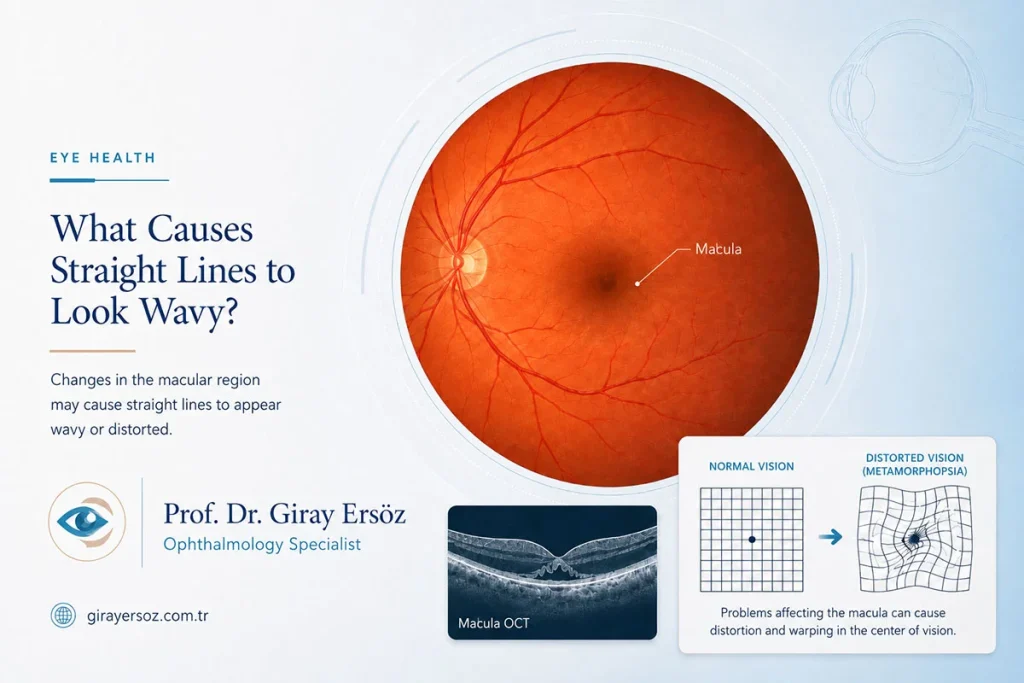
Straight lines may sometimes no longer appear straight to the eye. If door frames, window edges, tile lines, lines of text, or grid patterns appear wavy, bent, broken, or distorted, this may suggest more than simple eye fatigue.
Medically known as metamorphopsia, this symptom may be seen especially in diseases related to the macula, the central part of the retina responsible for sharp central vision. Therefore, if seeing straight lines as wavy has recently started, is noticed in one eye, or is accompanied by blurred central vision, an eye examination should not be delayed.
What Does It Mean to See Straight Lines as Wavy?
Seeing straight lines as wavy often suggests that the image is not being perceived properly in the central visual area of the eye. This is different from simple blurred vision.
When an eyeglass prescription changes, the person usually complains of not seeing clearly at distance or near. However, seeing lines as broken, wavy, distorted, or bent may be more closely related to problems in the macula or retina.
This symptom may sometimes occur only in one eye. A person may not notice the problem when both eyes are open. For this reason, people who think they are seeing straight lines as wavy are advised to check each eye separately.
Which Diseases Can Cause Straight Lines to Look Wavy?
Seeing straight lines as wavy may occur in different retinal and macular diseases. Instead of explaining these diseases in detail again in this article, it is more useful to visit the relevant disease pages for further information.
Eye diseases that may cause this condition include:
- Epiretinal Membrane
- Macular Hole
- Macular Degeneration
- Diabetic Retinopathy
- Retinal Vein Occlusion
- Central Serous Retinopathy
- Vitreomacular Traction Syndrome
The common point of these diseases is that they may affect the macula, which is responsible for central vision. However, each disease has different causes, follow-up processes, and treatment approaches. Therefore, the underlying cause of the complaint can only be understood through a detailed eye examination.
Which Symptoms May Accompany This Condition?
Seeing straight lines as wavy may occur alone or together with additional symptoms. These symptoms may indicate that the underlying condition needs to be evaluated more carefully.
Complaints that should be considered together with seeing straight lines as wavy include:
- Blurred central vision
- A dark or gray spot in the center of vision
- Missing parts of letters while reading
- Seeing objects smaller or larger than they are
- Seeing colors as faded
- Sudden blurred vision in one eye
- Flashes of light
- New or increasing floaters
- A curtain-like shadow or darkening in the visual field
An eye examination should not be delayed, especially if the complaint has recently started, is more noticeable in one eye, or is accompanied by central vision loss.
Is It Useful to Do an Amsler Grid Test at Home?
The Amsler Grid test is a simple monitoring test made up of square grid lines. It can help a person notice whether there is bending, breaking, waviness, or missing areas in the lines.
However, this test does not provide a diagnosis. A normal test result does not necessarily mean that there is no macular disease. Similarly, seeing the lines as wavy does not show which disease is responsible on its own.
If the test is performed at home, each eye should be evaluated separately. One eye is covered, and the grid is viewed with the other eye. If the lines appear bent, broken, erased, or if a central spot is noticed, an ophthalmologist should be consulted.
Which Examinations and Tests Are Performed for Diagnosis?
In patients who complain of seeing straight lines as wavy, the first step is a detailed eye examination. Visual acuity is assessed, and the front and back structures of the eye are examined. In some patients, a dilated fundus examination may be required to evaluate the retina and macula more clearly.
One of the most commonly used tests for this complaint is OCT, or optical coherence tomography. OCT shows the layers of the macular region in detail and helps with the diagnosis and follow-up of many retinal diseases.
In some patients, eye angiography may also be needed. Eye angiography can be used to evaluate leakage, bleeding, blockage, or abnormal blood vessel development in the retinal vessels.
The necessary test is determined according to the patient’s complaints, examination findings, and the ophthalmologist’s evaluation.
How Is Treatment Planned?
The treatment of seeing straight lines as wavy varies depending on the underlying cause. Therefore, the correct diagnosis must first be made.
While follow-up alone may be sufficient in some patients, intraocular injection treatment, laser treatments, photodynamic therapy, or surgical methods may be considered in some cases.
The important point is that the person should not try to diagnose themselves. The same symptom may be seen in different retinal diseases. For this reason, if seeing straight lines as wavy has recently started, is increasing, or is accompanied by impaired central vision, a retinal examination is appropriate.
Seeing straight lines as wavy should not be considered simple eye fatigue. Especially if it is noticed in one eye, has recently started, or is accompanied by blurred central vision, it should be evaluated in terms of macular and retinal diseases.
References
- National Eye Institute – Age-Related Macular Degeneration
- National Eye Institute – Macular Hole
- National Eye Institute – Macular Edema
- National Eye Institute – Macular Pucker

When Are Flashes of Light in the Eye Dangerous?
Sudden bright lights in the eye, short flashes similar to lightning, or a sudden sensation [...]
Devamını OkuyunSep
What Causes Computer-Related Eye Strain?
Complaints of eye strain have increased noticeably as computers and other digital screens have become [...]
Devamını OkuyunAug
What Causes Straight Lines to Look Wavy?
Straight lines may sometimes no longer appear straight to the eye. If door frames, window [...]
Devamını OkuyunAug
What Is Smartphone Blindness? Can It Cause Temporary Vision Loss?
Have you ever noticed short-term vision loss in one eye after looking at your phone [...]
Devamını OkuyunJul
How Can I Tell If My Eye Prescription Has Increased?
Your eye prescription may change over time. Sometimes this change is not noticed immediately; instead, [...]
Devamını OkuyunJul
What Causes a Sudden Curtain-Like Shadow Over the Eye?
If you suddenly experience a darkening, shadowing, or closing sensation as if a curtain has [...]
Devamını OkuyunJul
How Is an Eye Examination Performed? When Should It Be Done in Babies and Children?
An eye examination is a medical evaluation that is vital for protecting eye health and [...]
Devamını OkuyunJul
What Is Hyperopia (Farsightedness)? Causes, Symptoms and Treatment
Hyperopia is one of the most common vision problems seen both in Türkiye and around [...]
Devamını OkuyunJul