
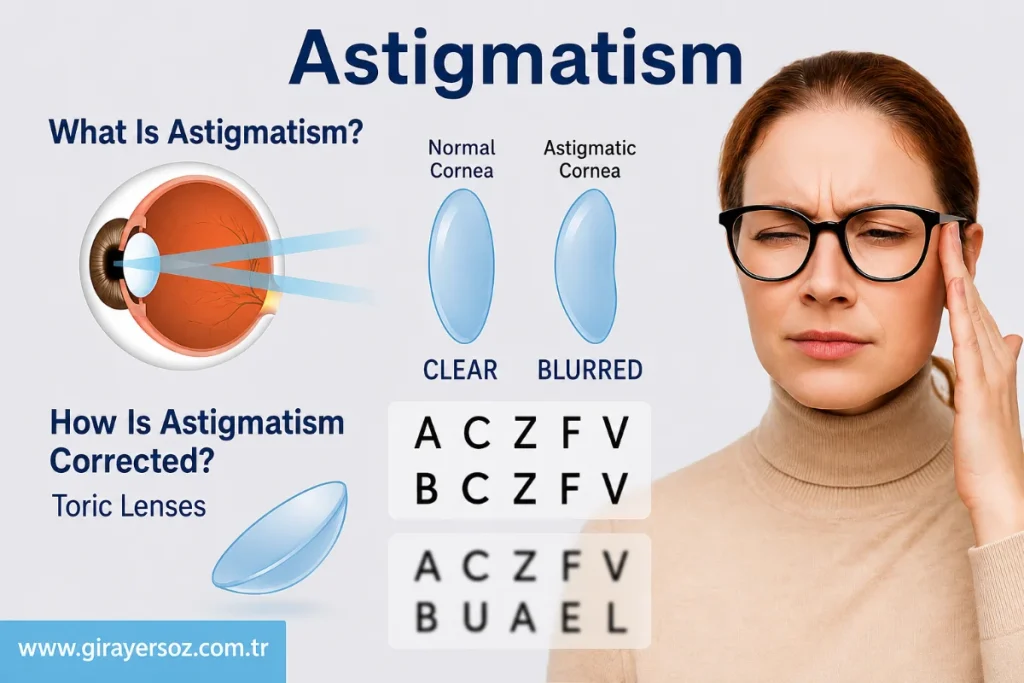
Astigmatism is one of the most common refractive errors affecting millions of people today. It occurs when the cornea or the lens of the eye is not perfectly round, causing blurred or distorted vision in both children and adults. Astigmatism may appear from an early age and can make everyday activities such as reading, driving or looking at a screen more difficult.
What Is Astigmatism?
Astigmatism is a refractive error caused by irregularities in the shape of the cornea or the lens of the eye. Normally, light entering the eye is focused at a single point through the cornea and lens. In astigmatism, however, light focuses at more than one point, causing vision to appear blurred or distorted. This condition is often present from birth, may occur at different levels in each eye and can be seen together with myopia or hyperopia. It can be corrected with glasses, contact lenses or surgical methods.
The prevalence of astigmatism has been reported to be between 26% and 36% in the 7–14 age group in Türkiye, while worldwide rates range between 11% and 44%. In addition, the frequency of astigmatism tends to increase again after the age of 55.
Anatomical Basis of Astigmatism
The main cause of astigmatism is that the cornea does not have an ideal round shape. When the cornea has an oval or irregular curvature, the refraction of light is disrupted. Irregularities in the lens or loss of lens flexibility may also contribute to this condition. Astigmatism may also develop due to genetic factors, eye trauma or previous eye surgery.
Irregularities in Corneal and Lens Curvature
The most typical cause of astigmatism is having different degrees of curvature in the horizontal and vertical axes of the cornea. When the irregularity originates from the lens, it is called lenticular astigmatism. These irregularities cause different refractive powers in different parts of the eye and lead to the image being focused at more than one point. Corneal topography can be used to determine the axis and severity of astigmatism.
How Is Light Refraction Affected in Astigmatism?
In astigmatism, light rays form two different focal lines instead of focusing at a single point on the retina. This causes blurred and distorted vision at both near and far distances. Lines may appear curved or wavy, and light sources may be seen with shadows, glare or double images.
Differences Between a Normal Eye and an Astigmatic Eye
In a normal eye, the cornea and lens have equal refractive power in all meridians. In an eye with astigmatism, this balance is disrupted, visual clarity decreases and contrast perception becomes weaker. Letters, lines or shapes may appear blurred. This can lead to eye strain, headache and difficulty focusing for long periods.
Symptoms and Diagnostic Methods of Astigmatism
The symptoms of astigmatism include blurred or distorted vision, eye strain, light scattering and headache. Symptoms may vary depending on the degree of astigmatism. Regular eye examinations are important for early diagnosis. A definite diagnosis can be made with optical tests and corneal topography.
Astigmatism and Headache
Astigmatism may cause headaches because the eye muscles constantly try to focus. This problem may become more noticeable after long periods of screen use or reading. Headache is usually felt around the forehead and temples. In children, reduced school performance and difficulty concentrating may be early signs.
How Does an Eye With Astigmatism See?
An eye with astigmatism perceives blurred and shadowed images at both near and far distances. The edges of objects may appear distorted, doubled or scattered. As the degree of astigmatism increases, the loss of clarity becomes more noticeable. In myopic astigmatism, distance vision is affected more, while in hyperopic astigmatism, near vision is affected more. In mixed astigmatism, vision at all distances may be affected.
Astigmatism Test and Eye Examination Process
Refraction testing, line-based vision tests and corneal topography are used in the diagnosis of astigmatism. These tests help determine the axis, degree and type of astigmatism. They are painless and take only a short time. For children and individuals in risk groups, an eye examination at least once a year is recommended.
Night Vision and Light Sensitivity Problems
People with astigmatism may see headlights and other lights as scattered or glaring when driving at night. Light sensitivity may increase and detail perception may decrease. Properly prescribed glasses or toric contact lenses can help reduce these problems. Laser treatment may also be considered when necessary.
Causes and Risk Factors of Astigmatism
Astigmatism may develop due to genetic predisposition, trauma, surgery or corneal diseases. It is mostly congenital but may also appear with ageing. Regular eye examinations are important for early diagnosis and effective management.
Genetic Factors and Family History
Having a family history of astigmatism increases the risk of developing this condition. In genetically related cases, regular follow-up examinations can help monitor progression. Children should have eye screening from the age of 3.
Eye Trauma and Post-Surgical Astigmatism
A blow to the eye or previous eye surgery may cause permanent changes in the shape of the cornea and lead to astigmatism. In such cases, special contact lenses, glasses or surgical treatment may be required. Medical follow-up plays an important role in recovery.
Keratoconus and Other Corneal Diseases
Keratoconus is a progressive disease in which the cornea becomes thinner and bulges forward. It is one of the main causes of irregular astigmatism. Early diagnosis and regular corneal topography follow-up can help slow progression. In some cases, contact lenses or intracorneal ring treatment may be used.
Ageing and Natural Changes in Eye Structure
As age increases, the flexibility of the cornea decreases, the structure of the lens changes and new cases of astigmatism may develop. These changes can be monitored and managed through regular eye examinations.
Degrees and Types of Astigmatism
Astigmatism is classified according to its degree as low (0.25–1.00), moderate (1.00–2.00) and high (above 2.00). Mild blurred vision may occur in low degrees, while significant visual loss may be experienced in higher degrees. Astigmatism may also be classified as regular or irregular.
Low, Moderate and High Astigmatism
Low astigmatism may often go unnoticed, but it can cause eye strain and headaches during long periods of screen use. In moderate and high astigmatism, loss of clarity becomes more obvious and glasses or toric contact lenses may be needed.
Myopic, Hyperopic and Mixed Astigmatism
In myopic astigmatism, distance vision is affected more. In hyperopic astigmatism, near vision is affected more. In mixed astigmatism, both near and distance vision may be affected. Different diopter calculations are made for each type.
Regular and Irregular Astigmatism
Regular astigmatism can usually be corrected easily with glasses or contact lenses. In irregular astigmatism, special contact lenses or surgery may be required because of corneal irregularities.
What Are the Treatment Methods for Astigmatism?
Astigmatism treatment is planned according to the patient’s age, degree of astigmatism and lifestyle. Glasses and contact lenses are the most commonly used options. Laser surgery, such as LASIK or PRK, can permanently correct astigmatism up to 6 diopters. In suitable candidates, visual quality can improve significantly in a single session. In addition, astigmatism can also be corrected with toric intraocular lenses during lens surgery in individuals over the age of 45.
You can find detailed information about LASIK in my article “What Is LASIK Eye Surgery? Who Is Suitable for the LASIK Method?”
Non-Surgical Treatment
In low-degree astigmatism, glasses or contact lenses are usually preferred. With the Ortho-K method, also known as night lenses, the cornea can be temporarily reshaped. Taking regular breaks while working at a screen can also help reduce eye strain.
Frequently Asked Questions
What Happens If People With Astigmatism Do Not Wear Glasses?
Untreated astigmatism may lead to eye strain, headache, loss of concentration and accidents in the long term. In children, not treating astigmatism may increase the risk of lazy eye, also known as amblyopia. Regular use of glasses helps prevent these risks. However, wearing glasses does not reduce the degree of astigmatism.
Can Toric Contact Lenses Correct Astigmatism?
Toric contact lenses provide clearer vision by helping light focus properly. They are planned according to the individual’s eye measurements and may reduce dependence on glasses for people with active lifestyles. It is essential to follow hygiene rules when using contact lenses.
What Can Astigmatism Cause?
Astigmatism causes blurred and distorted vision at both near and far distances.
Is Astigmatism Genetic?
Genetic factors play a role in the development of astigmatism. A child whose parent has astigmatism has a 2–3 times higher chance of developing astigmatism.
Why Does Astigmatism Increase?
One of the most important factors that can contribute to increasing astigmatism is the habit of rubbing the eyes. In addition, keratoconus is a serious eye condition that can cause astigmatism to progress very rapidly.
Can Astigmatism Progress Over Time?
Astigmatism may progress over time. If astigmatism progresses rapidly during adolescence, keratoconus should be investigated.
When Does Astigmatism Appear?
Astigmatism can appear at any age. Most commonly, it is present from birth. The frequency and degree of astigmatism may be higher in babies. These numbers usually decrease gradually until the age of 3. Astigmatism detected at the age of 3 is generally permanent and may increase gradually in later years.
Does Every Myopic Person Have Astigmatism?
No. Not every person with myopia has astigmatism.
Does Wearing Contact Lenses Cause Astigmatism?
No. Wearing contact lenses does not cause astigmatism.
Can Astigmatism Cause Blindness?
No. Astigmatism does not cause blindness.
What Does Astigmatism in One Eye or Bilateral Astigmatism Mean?
Bilateral means affecting both eyes. Bilateral astigmatism means that astigmatism is present in both eyes.
Can Astigmatism Be Corrected With Glasses?
When people with astigmatism wear glasses, their vision improves. When they remove the glasses, their vision returns to its previous state. In other words, wearing glasses does not reduce the degree of astigmatism. However, in children, glasses may help prevent lazy eye. For more information about lazy eye, you can read my article “What Is Lazy Eye? Causes and Treatment Methods for Lazy Eye”
Can People With Myopia and Astigmatism Wear Contact Lenses?
Contact lenses can be used for astigmatism, myopic astigmatism and hyperopic astigmatism. However, soft contact lenses available on the market can usually correct astigmatism up to 2.75 diopters. Higher degrees may require rigid contact lenses.
Can Coloured Contact Lenses Be Used in Eyes With Astigmatism?
Coloured contact lenses with toric properties that correct astigmatism are generally not available on the market. However, there is usually no problem with a patient with astigmatism using coloured lenses without prescription power.
Do Ortho-K Night Lenses Work for Astigmatism?
Yes. These lenses can also be used to temporarily correct astigmatism.
Can Astigmatism Be Corrected With Laser Eye Surgery?
Astigmatism can be corrected with laser eye surgeries, commonly known as laser vision correction. You can find detailed information about laser eye surgery in my article “What Is Laser Eye Surgery? How Is Laser Eye Surgery Performed?”
Which Laser Method Is Suitable for Astigmatism?
One of the most effective laser methods for correcting astigmatism is LASIK.
Can Hyperopic Astigmatism Be Treated With Laser?
Yes. Laser treatment can also be performed for hyperopic astigmatism in suitable patients.
Can Astigmatism Be Corrected During Cataract Surgery?
If a toric intraocular lens is placed in the eye during cataract surgery, astigmatism can be corrected.
Can a Smart Lens Be Implanted in an Eye With Astigmatism?
If an eye that will undergo smart lens surgery has astigmatism, toric smart lenses should be used.
Until What Age Does Astigmatism Progress?
Astigmatism usually does not change significantly between the ages of 20 and 50. However, in some cases, astigmatism may continue to progress after the age of 20.
Can Myopia and Astigmatism Progress Together?
Yes. They may progress together.
Can Astigmatism Regress or Go Away on Its Own?
After the age of 3, astigmatism does not usually regress or disappear on its own.
Can Astigmatism Improve in Children and Babies?
Astigmatism in babies may decrease until the age of 3.
Is Astigmatism an Obstacle for the National Defense University (MSÜ)?
Astigmatism up to 1 diopter is not an obstacle for MSÜ.
Source
- Astigmatism Explained: Causes, Diagnosis, Treatment
- Astigmatism – Symptoms and Causes
- Astigmatism – Diagnosis and Treatment
- Astigmatism
- Astigmatism – StatPearls
- Frequency of Refraction Errors among School-age Children in Ankara, Turkey
- Frequency of Refraction Errors among School-age Children in Ankara, Turkey: A Cross-Sectional Study
- What Is Orthokeratology?
- Use of Orthokeratology for the Prevention of Myopic Progression in Children
- LASIK Eye Surgery

What Is Optogenetics? New Hope in the Treatment of Vision Loss
I consider the awarding of the 2026 Nobel Prize in Physiology or Medicine for work [...]
Devamını OkuyunOct
Can Your Eyes Improve If You Stop Wearing Glasses?
Sometimes patients or parents ask the following question: “Can the eyes improve if someone stops [...]
Devamını OkuyunOct
When Are Flashes of Light in the Eye Dangerous?
Sudden bright lights in the eye, short flashes similar to lightning, or a sudden sensation [...]
Devamını OkuyunSep
What Causes Computer-Related Eye Strain?
Complaints of eye strain have increased noticeably as computers and other digital screens have become [...]
Devamını OkuyunAug
What Causes Straight Lines to Look Wavy?
Straight lines may sometimes no longer appear straight to the eye. If door frames, window [...]
Devamını OkuyunAug
What Is Smartphone Blindness? Can It Cause Temporary Vision Loss?
Have you ever noticed short-term vision loss in one eye after looking at your phone [...]
Devamını OkuyunJul
How Can I Tell If My Eye Prescription Has Increased?
Your eye prescription may change over time. Sometimes this change is not noticed immediately; instead, [...]
Devamını OkuyunJul
What Causes a Sudden Curtain-Like Shadow Over the Eye?
If you suddenly experience a darkening, shadowing, or closing sensation as if a curtain has [...]
Devamını OkuyunJul