
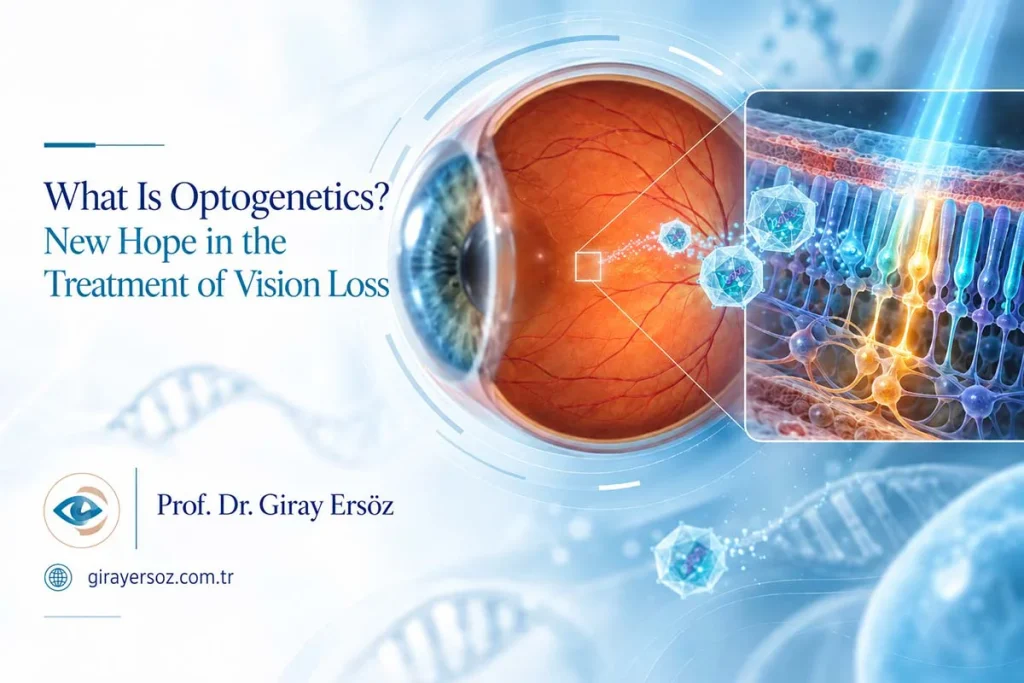
I consider the awarding of the 2026 Nobel Prize in Physiology or Medicine for work in optogenetics an important development, particularly for the treatment of vision loss caused by inherited retinal diseases.
In this article, I answer the following questions: What is optogenetics, how can it be used in eye diseases, and can it help restore lost vision?
What Is Optogenetics?
Optogenetics is a method that allows cellular activity to be controlled using light through light-sensitive proteins. With this method, certain cells that are not normally sensitive to light can be genetically modified to respond to light. Their activity can then be controlled using light.
Initially studied mainly in nerve cells, optogenetics has now become an important area of research for treating retinal diseases that cause vision loss.
What Is Optogenetic Therapy?
Optogenetic therapy is an experimental treatment approach that aims to restore certain visual functions in patients who have lost their vision.
The eye contains cells called photoreceptors, which detect light. In some retinal diseases, these cells gradually die, while some of the other nerve cells in the retina may remain intact. This is where optogenetic therapy comes into play.
In the methods currently being investigated, genetic material that enables the production of light-sensitive proteins is delivered to retinal cells through an injection into the eye. The aim is to make cells that do not normally detect light directly capable of responding to it.
Some approaches use special glasses that modify light signals, while others aim to enable retinal cells to respond directly to ambient light.
The goal is not to regenerate photoreceptor cells that have died, but rather to restore visual perception by making use of the cells that remain intact in the retina.
Why Was the 2026 Nobel Prize in Physiology or Medicine Awarded for Optogenetics?
The 2026 Nobel Prize in Physiology or Medicine was awarded to Karl Deisseroth, Peter Hegemann, and Georg Nagel for their discoveries in optogenetics.
Their work paved the way for controlling nerve cells using light. Over time, it became clear that this technology could be used not only in nervous system research but also in the development of treatments for different diseases.
From an ophthalmological perspective, the most important development has been the ability to make surviving retinal cells light-sensitive in patients who have lost their photoreceptor cells.
This approach represents an important step toward developing new treatment methods, particularly for inherited retinal diseases.
Which Eye Diseases Could Be Treated with Optogenetic Therapy?
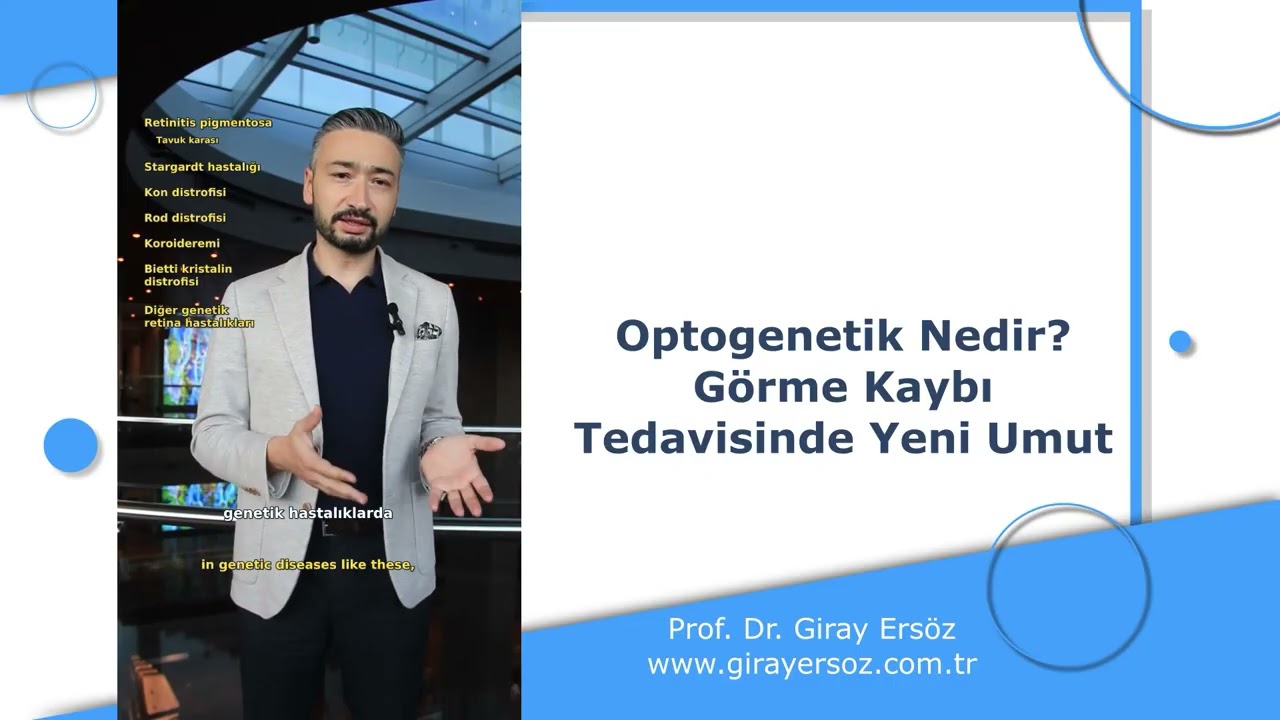
One of the diseases most extensively studied in optogenetic therapy is retinitis pigmentosa, commonly associated with night blindness.
In the future, optogenetic therapy may also become a treatment option for inherited retinal diseases such as Stargardt disease, cone dystrophy, cone-rod and rod-cone dystrophies, choroideremia, and Bietti crystalline dystrophy.
In these diseases, the cells responsible for detecting light may gradually become damaged or be lost. However, if some of the other retinal cells remain intact, it may be possible to benefit from optogenetic approaches.
Researchers are also investigating whether this technology could be used in cases of severe vision loss caused by certain non-genetic retinal diseases.
However, it is important to remember that optogenetic therapy has not yet been proven effective for all the diseases mentioned above. The most significant clinical results obtained in humans have come from studies involving retinitis pigmentosa and Stargardt disease.
What Are the Initial Results of Optogenetic Therapy?
Several important clinical studies on optogenetic therapies have been conducted in recent years. The results of studies involving retinitis pigmentosa and Stargardt disease have attracted particular attention.
Results in Patients with Retinitis Pigmentosa
In October 2026, a study published in The New England Journal of Medicine investigated optogenetic therapy in 10 patients with severe vision loss caused by advanced retinitis pigmentosa.
Genetic material designed to enable the production of light-sensitive proteins was injected into one eye of each patient. The effects of the treatment were evaluated using special light-stimulating glasses.
The study found increased light sensitivity in 7 of the 10 patients, with clinically meaningful improvement observed in 6 patients.
These results are encouraging because they suggest that light perception may be restored in patients who have lost a substantial number of their photoreceptor cells.
Results in Patients with Stargardt Disease
Another condition being investigated for optogenetic therapy is Stargardt disease. In the STARLIGHT study, published in eClinicalMedicine in 2025, six patients with Stargardt disease received an optogenetic treatment called MCO-010.
Improvements in visual acuity were reported in some patients. However, because the study involved a small number of patients and did not include a control group, the results need to be evaluated in larger studies.
Nevertheless, this development shows that optogenetic therapy is also being investigated for other inherited retinal diseases.
Can Optogenetic Therapy Fully Restore Vision?
One of the questions my patients are most interested in is whether this treatment can completely restore lost vision.
Although the results obtained so far are promising, optogenetic therapy has not yet been shown to restore normal vision completely.
Studies have reported improvements in functions such as detecting light, recognizing certain shapes, and performing specific visual tasks. However, the findings so far do not indicate that patients have regained the clear and detailed vision they previously had.
In addition, the treatment may not be suitable for every patient. The condition of the surviving retinal cells, the preservation of visual pathways, and the stage of the disease may influence treatment success.
Research is therefore continuing to determine which patients may benefit most from treatment and how long the improvements may last.
When Will Optogenetic Therapy Become Available?
Optogenetic therapies are not yet among the treatments we routinely perform in hospitals. However, there have been important developments toward their clinical use.
In September 2026, the U.S. Food and Drug Administration (FDA) accepted for review the biologics license application for MCO-010 (MOGENRY), an optogenetic treatment developed for patients with retinitis pigmentosa and severe vision loss.
Although this application represents an important development, its acceptance for review does not mean that the treatment has been approved. The regulatory review process has not yet been completed.
We hope to see significant progress in this field over the next 5–10 years, with optogenetic therapies becoming available for use in hospitals. However, it is not currently possible to predict exactly when these treatments will become widely available.
The results achieved in optogenetics are particularly valuable for patients experiencing severe vision loss due to inherited retinal diseases. As research progresses, we expect these methods to play an important role in the treatment of vision loss.
Kaynakça
- The Nobel Prize – Nobel Prize in Physiology or Medicine 2026
- The New England Journal of Medicine – Optogenetic Therapy for Restoring Aspects of Visual Function (2026)
- eClinicalMedicine – Safety and Efficacy of MCO-010 Optogenetic Therapy in Patients with Stargardt Disease (2025)
- Nanoscope Therapeutics – FDA Acceptance of the MOGENRY Biologics License Application (2026)

What Is Optogenetics? New Hope in the Treatment of Vision Loss
I consider the awarding of the 2026 Nobel Prize in Physiology or Medicine for work [...]
Devamını OkuyunOct
Can Your Eyes Improve If You Stop Wearing Glasses?
Sometimes patients or parents ask the following question: “Can the eyes improve if someone stops [...]
Devamını OkuyunOct
When Are Flashes of Light in the Eye Dangerous?
Sudden bright lights in the eye, short flashes similar to lightning, or a sudden sensation [...]
Devamını OkuyunSep
What Causes Computer-Related Eye Strain?
Complaints of eye strain have increased noticeably as computers and other digital screens have become [...]
Devamını OkuyunAug
What Causes Straight Lines to Look Wavy?
Straight lines may sometimes no longer appear straight to the eye. If door frames, window [...]
Devamını OkuyunAug
What Is Smartphone Blindness? Can It Cause Temporary Vision Loss?
Have you ever noticed short-term vision loss in one eye after looking at your phone [...]
Devamını OkuyunJul
How Can I Tell If My Eye Prescription Has Increased?
Your eye prescription may change over time. Sometimes this change is not noticed immediately; instead, [...]
Devamını OkuyunJul
What Causes a Sudden Curtain-Like Shadow Over the Eye?
If you suddenly experience a darkening, shadowing, or closing sensation as if a curtain has [...]
Devamını OkuyunJul