
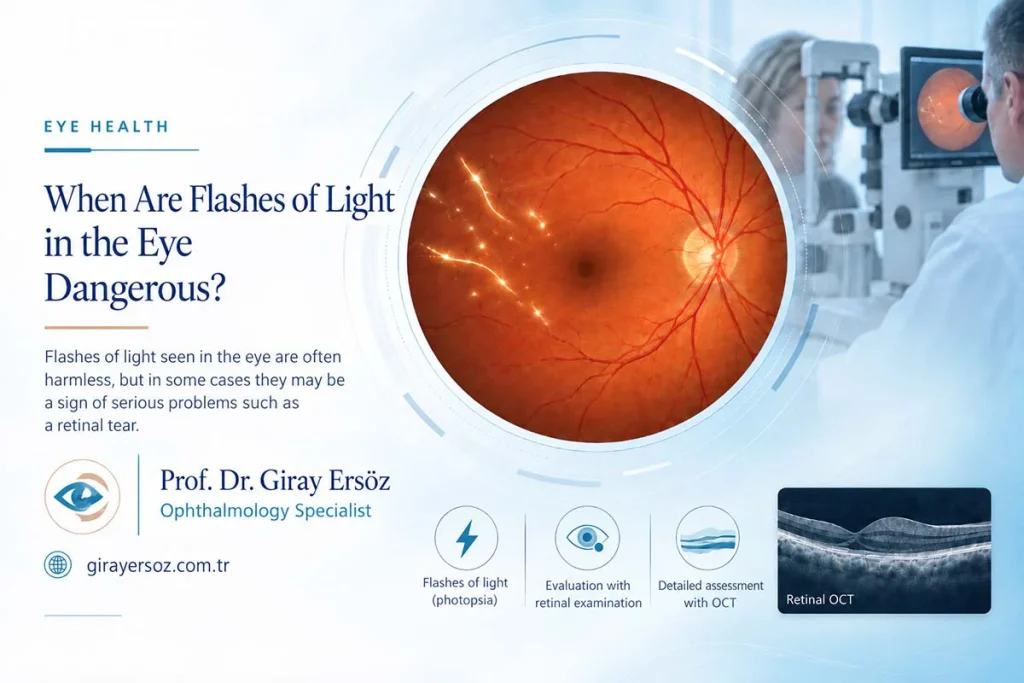
Sudden bright lights in the eye, short flashes similar to lightning, or a sudden sensation of light noticed in the dark can cause concern for many people. This condition may sometimes occur due to temporary causes. However, in some patients, it may be an important warning sign related to the retina.
Especially if flashes of light have recently started, are noticed in one eye, are gradually increasing, or occur together with floaters and a curtain-like shadow, an eye examination should not be delayed.
What Are Flashes of Light in the Eye?
Flashes of light in the eye refer to seeing flashes, sparks, lightning-like lights, bright lines, or sudden light bursts when there is no actual external light source. In medical terminology, this condition is called photopsia.
Flashes of light do not always mean a serious disease. However, in some cases, they may occur due to stimulation of the retina, which is located at the back of the eye. For this reason, newly developing flashes of light should be taken seriously.
What Causes Flashes of Light in the Eye?
Flashes of light in the eye may have different causes. These causes may vary from patient to patient. Age-related changes in the vitreous gel inside the eye and its pulling on the retina may cause a person to perceive flashes of light.
In some patients, flashes of light may be associated with more serious retinal conditions such as a retinal tear or retinal detachment. Especially if flashes of light are accompanied by eye floaters or a sudden curtain-like shadow over the eye, the retina should be evaluated more carefully.
The cause of flashes of light cannot be understood by symptoms alone. For this reason, the back layer of the eye, the retina, needs to be evaluated in detail.
When Are Flashes of Light Considered Dangerous?
Not every flash of light carries the same level of risk. However, in some cases, this symptom should be evaluated more carefully from a retinal perspective. I recommend that you do not delay an eye examination if you experience the following:
- Flashes of light started suddenly
- They are clearly felt in one eye
- They appeared together with floaters
- The number of floaters increased within a short time
- There is a curtain-like shadow, dark area, or shadowing in the visual field
- Decreased vision or blurred vision accompanies the complaint
- They started after an eye trauma
- There is a previous history of retinal tear or retinal detachment
- High myopia is present
- They were noticed newly after cataract surgery
These symptoms may require evaluation for a retinal tear or retinal detachment. In such a situation, it is safer to consult an ophthalmologist instead of waiting for it to “go away.”
What Does It Mean If Flashes of Light and Floaters Occur Together?
If flashes of light are accompanied by black spots, thread-like shapes, spider web-like images, or moving shadows, a retinal examination becomes more important.
Some people have had floaters for a long time and these may not change. This persistent condition may not always mean an emergency. However, if floaters have recently started, increased within a short time, or appeared together with flashes of light, they should be evaluated more carefully.
In this situation, the aim is to check whether there is a retinal tear, bleeding, or detachment. Newly developing floaters should be taken seriously, especially when they occur together with flashes of light.
Can Flashes of Light Be a Sign of a Retinal Tear?
In some patients, flashes of light may be an early sign of a retinal tear. Pulling of the retina by the vitreous gel inside the eye may be perceived by the person as flashes of light. In some patients, this traction may lead to a retinal tear.
If a retinal tear is detected at an early stage, argon laser treatment may be used in some patients to try to prevent the tear from progressing. However, the process is not the same for every patient. The treatment method and decision must be based on examination findings.
Can Flashes of Light Be a Sign of Retinal Detachment?
Flashes of light alone do not necessarily mean retinal detachment. However, if flashes of light are accompanied by a curtain-like shadow, shadowing, darkening, or sudden decrease in vision, retinal detachment may be present.
Retinal detachment is the separation of the retina from its normal position and is a serious eye disease that must be evaluated promptly because of the risk of vision loss. For this reason, if flashes of light are accompanied by a curtain-like shadow sensation or darkening in the visual field, I recommend having an examination without delay.
Are Migraine-Related Flashes of Light and Retina-Related Flashes of Light the Same?
During a migraine attack, bright shapes, zigzag lines, luminous areas, or temporary visual disturbances may be seen. These types of visual symptoms often disappear within a certain period of time.
Retina-related flashes of light should be taken more seriously, especially if they are noticed in one eye, occur together with floaters, or are accompanied by a curtain-like shadow. A person may not always be able to distinguish this reliably on their own. Therefore, an eye examination is important for flashes of light that are new, unusual, or accompanied by other visual complaints.
Who Should Be More Careful?
In some people, flashes of light should be taken more seriously. People who should be more careful can be listed as follows:
- People with high myopia,
- Those who have previously had a retinal tear,
- Those who have a retinal problem in the other eye,
- Those with a family history of retinal detachment,
- Those who have had eye trauma,
- People who have undergone cataract surgery,
- Those with sudden-onset intense floaters.
If flashes of light have recently started or are gradually increasing in these people, a retinal evaluation should be performed.
Which Examination Is Performed for Diagnosis?
In patients with flashes of light in the eye, a detailed eye examination is performed first. Visual acuity is evaluated, and the front and back structures of the eye are examined. To examine the retina more clearly, a dilated fundus examination is often required. During this examination, the eye is evaluated for retinal tear, bleeding, vitreous changes, or retinal detachment.
If the ophthalmologist considers it necessary, OCT, or optical coherence tomography or different retinal tests may also be requested. The necessary test is determined according to the patient’s symptoms and examination findings.
How Is Treatment Planned?
The treatment of flashes of light in the eye varies depending on the underlying cause. In some patients, no retinal tear or detachment is detected, and only follow-up may be recommended. In some patients, conditions that require treatment, such as a retinal tear, bleeding, or detachment, may be identified.
If a retinal tear is detected, laser treatment may be considered. If retinal detachment is present, surgical treatment, such as vitrectomy, may be required. However, these decisions are made individually for each patient according to examination findings.
In summary, it is not appropriate for a person experiencing flashes of light to try to determine the cause on their own. A retinal examination is appropriate, especially when flashes of light are new, increasing, or accompanied by other visual complaints.
Flashes of light in the eye do not always indicate a serious disease. However, if they are new, clearly noticeable in one eye, occur together with floaters, or are accompanied by a curtain-like shadow, they may be an important warning sign from a retinal perspective. Early evaluation is important for detecting conditions such as retinal tears and retinal detachment in a timely manner.
References
- National Eye Institute – Retinal Detachment
- National Eye Institute – Floaters
- National Eye Institute – Vitreous Detachment
- Mayo Clinic – Eye Floaters
- Mayo Clinic – Retinal Detachment

What Is Optogenetics? New Hope in the Treatment of Vision Loss
I consider the awarding of the 2026 Nobel Prize in Physiology or Medicine for work [...]
Devamını OkuyunOct
Can Your Eyes Improve If You Stop Wearing Glasses?
Sometimes patients or parents ask the following question: “Can the eyes improve if someone stops [...]
Devamını OkuyunOct
When Are Flashes of Light in the Eye Dangerous?
Sudden bright lights in the eye, short flashes similar to lightning, or a sudden sensation [...]
Devamını OkuyunSep
What Causes Computer-Related Eye Strain?
Complaints of eye strain have increased noticeably as computers and other digital screens have become [...]
Devamını OkuyunAug
What Causes Straight Lines to Look Wavy?
Straight lines may sometimes no longer appear straight to the eye. If door frames, window [...]
Devamını OkuyunAug
What Is Smartphone Blindness? Can It Cause Temporary Vision Loss?
Have you ever noticed short-term vision loss in one eye after looking at your phone [...]
Devamını OkuyunJul
How Can I Tell If My Eye Prescription Has Increased?
Your eye prescription may change over time. Sometimes this change is not noticed immediately; instead, [...]
Devamını OkuyunJul
What Causes a Sudden Curtain-Like Shadow Over the Eye?
If you suddenly experience a darkening, shadowing, or closing sensation as if a curtain has [...]
Devamını OkuyunJul